LIKE THE PAGE IF U LIKE IT...
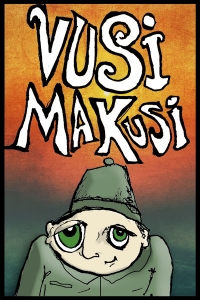
Vusi Makusi
Vusi
Makusi was a terminal optimist. He was an optimist even though he lived
in one of the poorest places in the world, even though he only owned
one suit, and his trousers didn't reach his ankles.
When he had finished his education, Vusi Makusi decided the civil
service would be a good career. The man in charge took one look at Vusi,
and saw immediately that he would never amount to anything.
"You know, I think I have just the post for an ambitious young man," he said.
Vusi spent a long time on a bus. The bus shuddered and shook and
clanked, passing deeper and deeper into the jungle. Eventually it came
to a halt in a swampy hollow, entirely surrounded by forest.
"But where is the village?" asked Vusi.
The bus driver pointed.
"What day does the bus return?"
"Saturday," said the bus driver, grumpily. Vusi had spent the last
twenty hours telling everyone on the bus about his new job, and the
driver was sick of him.
Vusi tramped through the hills to the village. He knocked on the door
of the chief's hut, and sat down to wait. The whole village came to
stare at him. When at last the chief appeared, Vusi stood up.
"Good Sir," he said. "I am the new government officer for this area. I
have come to bring peace, prosperity, unity, development, and education
to the people. I have come to show the beneficence and munificence of
our great and benign government. Whatever the village needs, whether it
be roads, schools, seeds, water, tractors, teachers or doctors, the
government is willing to provide. All I must do is make a list, and it
will certainly arrive."
The chief stared at Vusi, then began to laugh. He laughed ah-ha, ah-ha,
ahhhhhhhh-hahahahahah. The people rolled around, slapping each other in
mirth.
"Young man," said the chief, at last. "It is some time since we have had a visiting comedian."
"But Sir," said Vusi. "I am quite serious."
The chief laughed some more, ahahahahah!
"Good Sir, please desist! Cannot you see that my respected mother, 83
years old, is in pain from your joshing? Do you want an old lady to
break her ribs?" he cried.
That night there was a special dinner for Vusi. It was only the next
day, when Vusi began touring the village with a clipboard, that they
became worried.
"He is a lunatic, and they have cast him out from the city," said the priest.
"He is a spy, and is making that list so they can steal everything," said the chief's wife.
"I think he has hit his head, and that is why he strange," said the blacksmith.
When twenty-eight days had passed, Vusi visited the chief. He explained
that he had worked four weeks in a row, was due eight days leave, and
that he intended to visit his elderly mother. He also asked to borrow
the chief's umbrella, and offered to buy him a new one, just as soon as
he got to the city, where he could draw his shiny new government salary
from his shiny new bank account.
The chief, shaking his head, agreed to lend him the umbrella. Vusi went
to the chief's wife and asked to borrow a blanket. Then he went next to
the village blacksmith and asked for a knife, since it was a long walk
to the bus stop, and the path was overgrown. Then he walked off,
carrying his battered suitcase.
"Surely somebody should tell him, there is no bus," said the chief.
They waited and waited. Eventually the blacksmith went down the valley and found Vusi waiting by the dirt track.
"He says the bus will surely come soon," explained the blacksmith, "And
he does not want to miss it." When two days had passed, the chief
himself descended and tried to talk sense to Vusi. He returned, shaking
his head. The priest tried, with no more success.
"He is immune to reason," said the chief's wife. "Therefore we must
appeal to the heart, or the eyes. Send the potter's daughter, she is the
prettiest girl in the village."
The potter's daughter returned, shrugging hopelessly.
"Send the priest's niece," suggested the blacksmith. "She is not
perhaps quite the prettiest, but the smartest and sharpest of the women,
and clever with words."
The villagers worked their way through all the young women, till there was only one left.
"Well, she might as well try," said the chief, yawning. Then he went inside, for a nap.
The girl stormed off down the path. She was so angry to be considered
the plainest and stupidest girl in the village that when she saw Vusi,
she threw a mango stone at him.
"Idiot! Lunatic!" she shouted. "Do what you want and see if I care! Do
you think anyone will even notice if you sit there till you turn to
stone!" Then, because she was so upset, she burst into tears.
Vusi stared at the girl. He fell to his knees.
"Dear lady," he said, "You must forgive me! This excess of emotion can
only have been brought on by the burden of concealing your true
feelings. If I seemed oblivious to your affections it is only that you
had not declared them. Why, if I had known that you loved me, I should
never have behaved so callously. What good news! When the bus arrives,
and I go and see my mother, I shall tell her I have met my future wife.
Praise the lord! Until then, perhaps you will be so kind as to pass a
little while with me, waiting."
Since all this was a good deal more pleasant than being told she was
plain and stupid, the girl consented to wait. Vusi began to tell her
about the future, and how wonderful everything would be. He told her
about the tractors and clinics and schools and water pumps and fat cows
and plump chickens and huge vegetables and smiling people and tin roofs
and television and clean toilets and post offices and telephones and
paved roads and airplanes and skyscrapers and regular, timely buses to
all rural destinations.
In the morning it began to rain. Vusi put up the chief's umbrella. It
rained and rained. A small red monkey appeared and sat on the far side
of the track. It looked sad and bedraggled.
"Look, the monkey is waiting to get on the bus!" said Vusi.
"But Vusi, he does not have a bag, or a suitcase," said the girl.
"You are right," agreed Vusi, "Therefore it is expecting relatives to arrive on the bus, and is waiting to greet them."
After a while the monkey began to shiver.
"Vusi," said the girl, "Either let the monkey come under the umbrella,
or chase it away. I cannot stand looking at its sad face any longer."
"Why, of course it must come under the umbrella," said Vusi. "After all
the monkey too is a citizen of our great and glorious nation."
The monkey, Vusi, and the girl sat under the umbrella. It went on raining. A great pool built up in the hollow.
"Surely," said the girl, who was coming to understand how Vusi thought,
"The people of our great nation should not have to wait for buses in
the rain. Since you are the government officer, you could cut branches
and make a shelter while we are waiting. This would be a service for all
the people."
"I see you are not just a pretty face," said Vusi, nodding. "Only, if
the bus comes while I am cutting branches, you must shout and call me,
for I do not want to disappoint my elderly mother."
So Vusi took the knife and cut branches, and made a shelter.
Vusi and the girl waited in the shelter. The monkey sat in the roof.
Another day passed, and another and another. The rain ceased, briefly.
The chief of the village came down the track. He shook his head, and
went home. The pool in the river continued to widen, and Vusi caught a
fish for dinner. Nothing passed on the road, nothing whatsoever.
Vusi and the girl waited in the shelter. They waited so long, the girl had a baby.
"How happy my mother will be when she sees the child!" cried Vusi.
"Surely, my husband" said the girl, "People will be waiting for buses
here with children. I think they must have a place to lie down, and
sleep quietly."
Vusi took the knife and cut more branches, and made a second room.
Outside the door, the mango stone sprouted, and grew leaves. A second
monkey moved in with the first one. The monkeys too had a baby. It
rained and it rained. The river rose and fell.
"Vusi," said the girl. "One day this will be a busy bus terminal. There
will be many passengers, and whoever can provide food and drink will
have a profitable business. I think I had better prepare, and plant corn
for porridge, and maize to make beer. Then you will not only be
government officer, but I will be a businesswoman."
So she turned up the soil by the riverbank, and planted a garden. Then she went in the hut, and had another baby.
"I do believe I must have misheard that gentleman," said Vusi, one day.
"Surely it cannot have been Saturday that the bus arrives, it must have
been January. Only there has been none for three years now. They will
arrive all at once, three of them. That is a famous habit of buses."
"Vusi," said the girl, "If there are three bus loads of people, I do
not have enough food. Besides, a good restaurant has a variety of
dishes. Go into the jungle, and catch a pair of those birds we have
seen, and I can keep them. That way, we will have enough for everyone."
"It is a good idea," said Vusi. "Only if the buses arrive and I am in the jungle, you must ask them to wait."
The girl stayed by the roadside, waiting. Nothing passed. Not even the
villagers came any more. After five days Vusi returned, clutching two
startled guinea fowl.
"I have not missed the bus?" he asked anxiously. His wife reassured him.
"It is the weather," said Vusi. "It has been very strange recently, and
I think the bus will not come this year. Nonetheless, since they are so
unpredictable, it would be a shame to leave this spot. Especially since
we have made so many preparations, with the hotel and the restaurant."
That year passed.
"Vusi," said the girl, "You must build a fence to keep the guinea fowl
in. It will not do if they are run over by the buses."
Another year passed.
"Vusi," said the girl, "The fish do not stay in the dry season. What if
the bus comes when there are no fish? How will I feed the passengers?
You must build a dam in the river."
Another year passed. The girl had another baby.
"Certainly this service is very unacceptable," said Vusi one day. "When
the bus does come to take us to the city, I will write a letter to the
minister of transport. The only good point, my wife, is that every week,
my salary is building up in my government-run bank account."
Another year passed. The bus did not come. The mango tree began
producing very good mangoes. They waited so long, Vusi began to worry
about who his eldest son would marry.
Then, one day a strange noise began in the jungle. It seemed to echo around.
"The bus! The bus!" cried Vusi's children, for they had heard from their father of this strange monster.
Over the edge of the hill came a white helicopter with the letters U.N.
painted on the side. It put down in the roadway, and four
nervous-looking soldiers in blue berets climbed out. Then a couple of
scientists in white coats, clutching clipboards, their faces covered
with hygienic masks. Finally came a politician in a suit, holding a
handkerchief to his nose, and a general, clutching a tin hat. They
stared at Vusi. They stared at his wife, and at his seven children.
"I see," said Vusi. "They are upgrading the service, and now there are
helicopters instead. That is why we have been waiting so long!"
"What are you doing here?" said the politician.
"Why, we are waiting for the bus," said Vusi, quite calmly.
"But how did you survive the civil war?" asked the general.
"Civil war?" said Vusi, looking puzzled.
"Yes, the civil war that wiped out half the population," said the politician.
"Certainly we have not seen any soldiers," said Vusi, shaking his head.
"But even if you escaped the civil war, how did you survive the famine that killed half the survivors?" asked the general.
"Famine?" said Vusi's wife. She looked around at the mango trees, the millet bushes, the coops with fat guinea fowl.
"Ok, even if you escaped the war and the famine, how did you survive the virus?" asked one of the scientists.
"Virus?" said Vusi. "What virus?"
"The deadly virus which wiped out all the survivors of the war and the
famine," said the second scientist. "You know, the incurably fatal one
to which no human or ape was immune, except for the extremely rare and
almost extinct lesser red-haired lemur?"
A small monkey climbed onto Vusi's shoulder and began to nibble his ear
in a familiar manner. Vusi brushed it off, distractedly.
"It is strange you say this," he said, thoughtfully. "I cannot remember any of us being sick."
"Vusi," said his wife, tugging at his elbow. "Invite them to dinner. They can be our first customers!"
"Certainly," said Vusi, nodding. "Fish or guinea fowl?"
But the politicians and the scientists and the soldiers looked quite terrified, and cringed back towards their helicopter.
"We have to go," said the General.
"Certainly we must get you out of here," said the politician,
forcefully. "You will get all kinds of things. Aid, assistance, help,
clean clothes, a house, electricity, a proper toilet, everything. You
will be famous, and newspapers will interview you."
"Why, thank you," said Vusi, politely. "But we cannot leave, we are
waiting for the bus. However there is one favour you can do for me. Do
you have paper and pen?"
Vusi sat down and penned a short note to the transport minister
complaining about the unreliability of rural buses. Then he put it in
the politician's hand.
After the helicopter had gone, Vusi seemed a little downcast.
"Famine, war, diseases, surely it cannot be true of our beautiful country?" he said.
"Perhaps they are lying," suggested his wife. "Let us walk to the top of the hill and see what is really happening."
Vusi and his wife walked up the old road that no-one had used for
years. It was covered in boulders, cracked and broken. Rivers had torn
it apart. At last, they came to the top of the hill. Vanishing into the
distance was a wasteland of flattened trees, burnt tanks, ruined
villages and abandoned fields.
Vusi and his wife walked home, hand in hand. Vusi was rather quiet. His
wife went to get dinner. Vusi sat down, his wife and children around
him. He looked very thoughtful. At last he spoke.
"My wife," he said, "I know that sometimes there are those who have
considered me a fool. Yet I cannot but think, that as I said, everything
I have done has turned out for the best."
If you liked this story, please let other people know:

No comments:
Post a Comment